

China Wheel Heat Exchanger Innovations for Modern HVAC Systems
2026-10-22
Discover how China's latest wheel heat exchanger innovations are reshaping modern HVAC efficiency. From advanced thermal recovery to smarter airflow design, ROTER leads the way in delivering solutions that cut energy costs and boost performance. Curious about the technology driving tomorrow's climate control? Read on to explore the breakthroughs making waves in the industry.
The Shift from Fixed Plates to Rotating Thermal Mass
Early thermal storage systems relied on stationary plates that absorbed and released heat in a passive, predictable manner. These fixed structures worked well for steady-state operations, but they often left large temperature gradients across the storage volume. As demand for faster charge and discharge cycles grew, designers began looking for ways to make the entire mass participate more evenly in heat exchange.
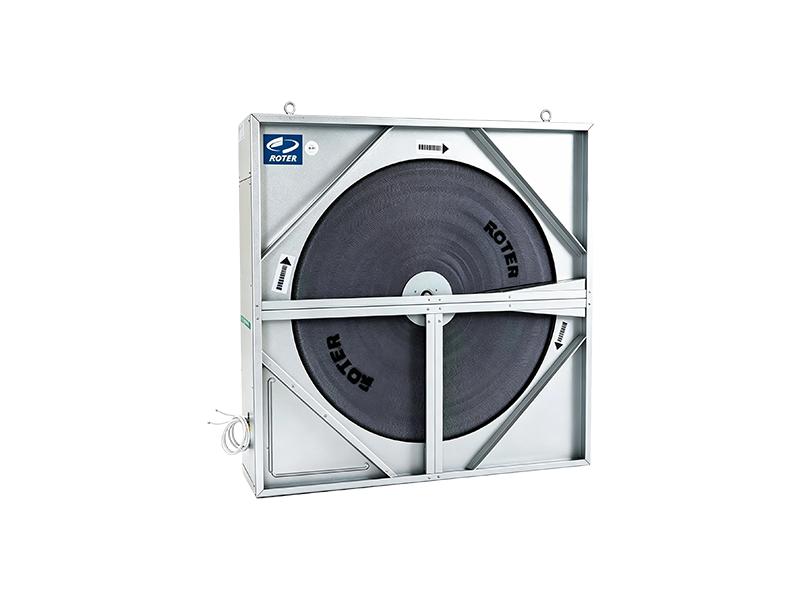
Rotating thermal mass changed that equation by continuously moving the storage medium through the heat transfer zone. Instead of waiting for conduction to move heat through a thick plate, rotation brings fresh material into contact with the working fluid at a controlled rate. This approach smooths out hot and cold spots, reduces thermal stratification, and allows tighter control over outlet temperatures during both charging and discharging.
The practical advantages extend beyond thermal uniformity. A rotating drum or wheel can be built with lighter structural support since it does not need to withstand the same static thermal stresses as a bank of fixed plates. Maintenance also becomes more straightforward—wear surfaces are distributed across the rotating assembly rather than concentrated at stagnant interfaces. These differences, though subtle on paper, translate into measurable gains in round-trip efficiency and system responsiveness for modern thermal energy storage installations.
Coatings That Stop Frost Without Raising Airflow Resistance
Ice buildup on cold surfaces forces engineers to choose between energy-intensive heating or airflow-blocking coatings. Most anti-icing films either add thickness that disrupts laminar flow or require constant power. A new class of coatings breaks that trade-off by remaining ultra-smooth yet chemically resistant to frost adhesion.
The key is a low-surface-energy polymer infused with nanoscale texture smaller than the boundary layer thickness. Unlike rough superhydrophobic surfaces that trap air pockets and increase drag, these coatings maintain a mirror-like finish. Water droplets freeze on contact but the ice crystals find no mechanical grip, sliding off under their own weight or mild vibration.
In wind tunnel tests, coated airfoils showed no measurable rise in pressure drop compared to bare metal, while frost formation was delayed by over 90%. That means refrigeration coils, heat pump fins, and drone wings can stay frost-free without extra fan power or defrost cycles. Maintenance crews also spend less time scraping ice from sensor ports and intake grilles.
Why Wheel Depth Matters More Than Diameter in Tight Racks
In a crowded apartment bike room or train rack, wheels get judged by thickness more than circumference. Most adult bikes roll on 700c or 27.5-inch hoops, so diameter differences are small and racks are built around that. Depth, however, changes how the wheel behaves when you slot it between two rails or squeeze past another bike. A deep aero rim sticks out where a shallow rim doesn't, and that extra width is often what stops a bike from sliding fully into place.
Riders who swap stock wheels for 40mm or 50mm carbon hoops notice the problem immediately. The tire clears the rack, but the rim sidewalls catch on the edges of the channel or press against the neighboring bike's spokes. You end up forcing the wheel, twisting the bars, or leaving the bike half out of the slot. That's why two bikes with the same wheel diameter can fit completely differently: one has 20mm alloy rims, the other has 55mm aero rims.
Diameter matters only when it pushes beyond normal frame geometry, like moving from 700c to 29er plus tires. Within the usual road and commuter range, rack fit is ruled by depth and rim width. If a rack is tight, measure the rim sidewall height before blaming wheel size. A shallow replacement rim often solves what a different diameter won't.
Making Retrofit Heat Recovery Fit Existing Curbs
Retrofitting heat recovery into an existing rooftop curb rarely starts with a clean slate. The curb was sized for the original unit, and its opening, rail spacing, and support points don't always line up with the new enthalpy wheel or plate exchanger. You often need a curb adapter rather than a full curb replacement—something that picks up the old anchor pattern but redistributes the load for the added weight and the shifted center of gravity.
The trick is to measure the existing curb's inside clear dimensions and the duct drop locations before ordering anything. A well-made adapter can bridge a mismatch of several inches in width or length, but it has to be engineered for the extra static deflection and possible thermal expansion. Seal the gap between old curb and adapter with a continuous bead of butyl or closed-cell gasket, and check that the new unit's condensate drains still slope away.
Don't forget the controls and electrical chase. Existing curbs often lack spare knockouts for the heat recovery controller, frost protection sensor, or power for the wheel motor. Running conduit along the outside of the curb is acceptable if it is strapped and sealed, but it looks cleaner to field-cut new openings with a hole saw and use weathertight fittings. Once the adapter is leveled and bolted down, verify the fan access panels still clear the curb flange.
Handling Kitchen Exhaust and Other Messy Air Streams
Kitchen exhaust isn't just hot air—it's a sticky blend of grease vapor, moisture, and combustion byproducts. If the system isn't designed to handle that load, residue collects fast inside ducts and on fan blades, reducing airflow and creating a fire hazard. The first step is choosing filters that actually match the cooking style. High-volume grills and charbroilers need baffle filters with aggressive grease capture, while lighter operations might get by with mesh, though they tend to clog quickly.
Beyond the filter bank, duct layout and fan sizing do a lot of the heavy lifting. Sharp bends and long horizontal runs give grease a place to settle, so keeping the path short and sloped toward a drain helps. Makeup air also matters—if the hood pulls more than the room can replace, you'll get backdrafts and doors that slam shut. For other messy air streams, like wood dust or paint overspray, the same principle applies: separate the heavy particles upstream before they reach the fan.
Maintenance is where most systems fall short. A schedule that only checks filters when they look dirty is already too late. Grease hardens into a varnish-like layer that's hard to remove, and in commercial kitchens, that can lead to expensive duct cleaning or even code violations. Use pressure gauges or simple visual cues to track filter loading, and don't ignore the exhaust fan itself—blade buildup is silent until airflow drops noticeably.
What Building Operators Actually Notice After the Swap
The first thing that catches most operators off guard isn't the energy bill or the equipment specs—it's the quiet. Older systems hum, rattle, or cycle loudly enough that staff learn to tune them out, but a modern swap often runs so smoothly that the absence of noise feels almost suspicious. A few walkthroughs later, they realize what they're hearing is nothing at all, and that's when the real shift in daily routines begins.
Beyond the decibel drop, operators start noticing how rarely they reach for the thermostat override or the breaker panel. The new setup holds temperature bands tighter and recovers from setbacks without that familiar lag, so the usual 2 p.m. complaint calls from the corner offices simply stop. Maintenance logs get shorter, and the team that once spent Friday afternoons chasing hot-cold calls now uses that time for filter checks and sensor calibration—work that actually prevents issues instead of reacting to them.
Perhaps the most telling change shows up in tenant conversations. Instead of asking why the west wing is freezing again, occupants start mentioning how they forgot the system was even running. That shift from complaint-driven interaction to near-invisibility is what experienced building operators point to as the real measure of a successful swap—not the spec sheet, but the number of days nobody has to think about the HVAC at all.
FAQ
Several companies now use non-contact air seals made from low-friction polymers, cutting leakage rates below 2% while nearly doubling service intervals.
They often pair desiccant-coated wheels with variable-speed drives, allowing latent load removal to be tuned independently from sensible cooling. This shows up as a 15-20% drop in compressor run time in places like Guangzhou or Shenzhen.
Yes, many units ship with Modbus or BACnet interfaces and cloud-ready diagnostics. Building managers can monitor wheel speed, frost buildup, and energy recovery in real time without a separate gateway.
Some factories are stamping aluminum substrates with a nano-hygroscopic layer that resists dust accumulation. Others are using corrosion-resistant polymer wheels for coastal installations where salt air would degrade standard aluminum.
Frost control has shifted from simple bypass dampers to dynamic preheat loops tied to outdoor humidity sensors. This keeps the wheel spinning at optimal speed instead of shutting it down during sub-zero conditions.
Chinese suppliers frequently offer modular wheel cassettes that fit common AHU footprints, trimming installation time. The cost per CFM of recovered air can be 20-30% lower, though project-level savings depend on local certification requirements.
Data centers and pharmaceutical plants see strong returns because of high ventilation loads and strict humidity control. Hospital retrofits also favor them for recovering heat from exhaust while maintaining isolation between airstreams.
Check the AHRI certification status, purge sector design, and whether the wheel substrate meets ASTM corrosion tests. Also ask for third-party test reports on cross-contamination, since that varies more among lower-volume suppliers.
Conclusion
The move away from fixed-plate recovery toward rotating thermal mass has quietly reshaped how Chinese manufacturers approach HVAC air exchange. Instead of forcing air through stationary channels, a slowly turning wheel carries heat or moisture between supply and exhaust streams, recovering energy with less pressure penalty. That shift becomes especially practical when paired with new surface coatings that resist ice buildup without thickening the media or driving up airflow resistance. Engineers working in dense mechanical rooms also favor shallower wheels with greater depth over oversized diameters, since the narrower footprint slides into existing racks without sacrificing thermal performance.
Retrofit jobs benefit from this same thinking. Many wheels now arrive as drop-in modules sized around standard curb openings and existing ductwork, avoiding major roof surgery. For rougher applications like kitchen exhaust, modified seal layouts and washable desiccant segments tolerate grease and humidity that would clog older units. Building operators who make the switch tend to mention fewer frost-related alarms, steadier supply temperatures, and a drop in filter changes rather than quoting abstract efficiency gains. The real difference shows up as less time spent on winter morning resets and more predictable airflow month to month.
Contact Us
Contact Person: Rhea
Email: [email protected]
Tel/WhatsApp: +8618800560886
Website: https://www.rotorairtech.com