

Recommend a Few Iron Casting Options for Your Next Project
2026-09-23
Choosing the right iron casting for your project can feel overwhelming—gray iron, ductile iron, and more all promise different strengths. But which one actually fits your needs? Whether you're balancing cost, machinability, or durability, the wrong pick can lead to costly rework. That's why we've narrowed down a few practical options worth considering, with insights from Zhaoyuqi, a trusted name in quality castings. Read on to discover which iron casting will keep your next project on track.
Gray Iron Damping Solves Problems You Didn’t Know You Had
That low-frequency hum in a gearbox housing or the faint edge chatter on a milled surface usually gets blamed on alignment, tool wear, or bearing play. Rarely does anyone suspect the material itself. Yet gray iron quietly removes a class of problems that stiffer metals simply pass along. Its graphite flakes, distributed through the pearlitic matrix, act like countless microscopic shock absorbers. When deflection waves ripple through a casting, those flakes slip and strain against the surrounding metal, turning mechanical energy into heat before it can build into resonance.
Steel tends to ring. Aluminum transmits vibration with little loss. Gray iron has a different relationship with motion. The flake graphite interrupts the elastic wave path far more effectively than the nodular graphite in ductile iron. That is why a well-aged gray iron machine base can hold tolerances during interrupted cuts that make a welded steel frame chatter. In brake discs, the same mechanism keeps squeal frequencies from locking in, and in engine blocks it damps the combustion pulses that would otherwise surface as harsh noise.
This damping does more than reduce annoyance. It protects surface finish, extends cutting tool life, and lowers the peak stress that leads to fatigue cracks at bolt bosses and webs. Designers often chase higher strength numbers, but a material with slightly lower tensile strength and far better damping can make a whole assembly quieter and more stable. Once you recognize the signature—a dull, short-lived ring instead of a sustained metallic ping—gray iron becomes less of a default choice and more of a deliberate fix.
Ductile Iron Stands Up to Loads That Would Shatter Gray Iron
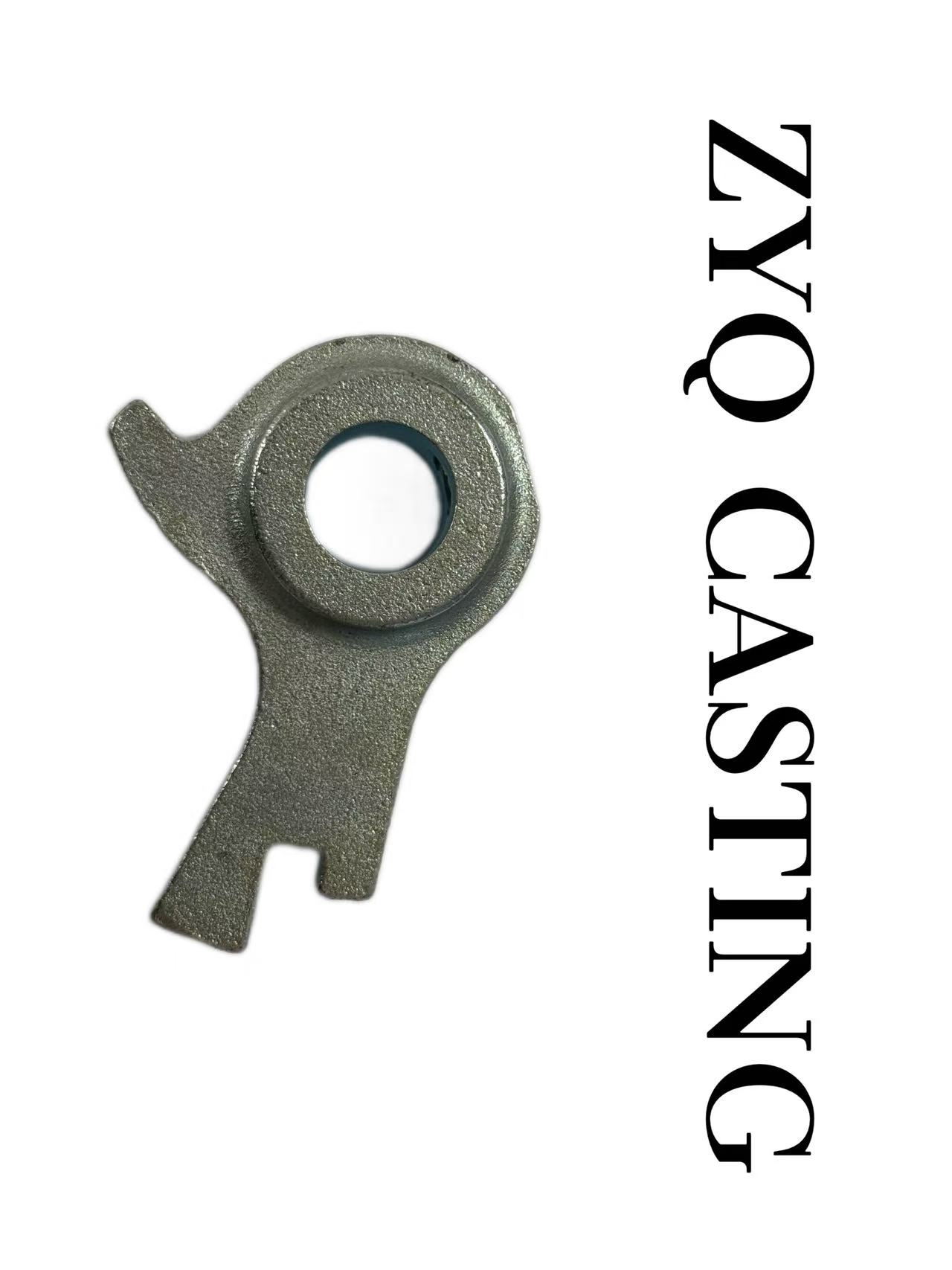
Gray iron earns its reputation for stiffness, but the graphite flakes that make it easy to machine also behave like tiny internal cracks. Under tensile or impact loading, stress piles up at the flake tips and drives fracture along weak graphite-rich planes. Ductile iron changes that geometry entirely: magnesium treatment converts the graphite into isolated spheroids. Those nodules interrupt the ferrite or pearlite matrix far less than flakes do, so cracks have to tear through continuous metal instead of following a ready-made path.
The difference shows up quickly in overload tests. A gray iron casting may hold a static compressive load well, then snap with almost no warning when pulled or struck, often at stresses below 30 ksi. Ductile iron in common grades carries 60 to 120 ksi in tension and typically reaches 10% elongation or more before failure. That yield-and-stretch behavior lets a ductile iron part dent, bend, or deform slightly under a severe load, giving operators and drivers an opportunity to notice damage before a complete break.
Suspension knuckles, differential housings, crankshafts, and gear cases now rely on ductile iron for exactly that reason. A pothole strike or a sudden driveline shock can momentarily double the nominal load. Where gray iron would crack at the first overload, ductile iron absorbs the spike through localized yielding, often remaining serviceable until the next inspection. The difference is less about raw hardness and more about how the metal distributes internal stress.
Malleable Iron Deserves a Second Look for Thin-Walled Castings
Malleable iron has a reputation problem. Many engineers associate it with old plumbing fittings or agricultural hardware, and they assume it can't match the ductility of steel castings or the machinability of gray iron. That view is outdated. When thin walls are required, malleable iron actually offers a compelling balance: its white iron base is castable at relatively low temperatures and then annealed to convert brittle carbides into nodular graphite, resulting in a material that handles vibration and impact far better than most people expect.
The real advantage shows up in sections under 3 mm. At that thickness, gray iron often falls short on strength, and ductile iron can be tricky to pour without defects. Malleable iron, by contrast, has a long history of filling intricate molds cleanly, and modern annealing cycles allow tighter control over the final microstructure. For thin-walled brackets, clamps, and automotive components, this can mean fewer scrapped parts and less secondary machining. It's not a universal replacement, but ignoring it may be costing you performance and yield.
Compacted Graphite Iron Finds Its Sweet Spot in Exhaust Systems
Exhaust manifolds and turbocharger housings live in a brutal world—constant thermal cycling, vibration, and oxidizing gases. Compacted graphite iron (CGI) has quietly become the material engineers reach for when they need a component that won’t crack after a few thousand hot-cold cycles. Its graphite particles, shaped like short, blunt worms rather than the flakes of gray iron or the spheres of ductile iron, create a unique balance of strength and thermal conductivity that fits the demands of modern exhaust systems remarkably well.
Compared to conventional gray cast iron, CGI offers roughly double the fatigue strength and far better resistance to thermal shock. Those worm-like graphite particles blunt crack propagation instead of letting it race along flake boundaries. At the same time, CGI retains enough thermal conductivity to manage heat distribution across the manifold, preventing hot spots that lead to warpage or failure. Ductile iron may be tougher, but it’s also harder to machine and cast into the thin-wall, complex geometries that exhaust components require. CGI threads that needle: it flows well into molds during casting, yet it doesn’t sacrifice the machinability that keeps production costs under control.
Automakers have found that switching exhaust manifolds to CGI allows wall thickness reductions of up to 30 percent compared with gray iron, trimming weight and improving thermal response. The material also pairs nicely with integrated turbocharger housings, where exhaust gas temperatures routinely exceed 900°C. Rather than trying to force a square peg into a round hole with existing iron grades, designers are treating CGI as its own material—not a compromise, but a sweet spot that has finally earned its place in the exhaust stream.
White Iron Chooses Wear Resistance Over Machinability
White iron's metallurgical makeup explains the trade-off. Massive chromium or iron carbides lock into the matrix, pushing hardness past 500 HB and often into the 600s. That same structure that laughs off abrasive slurry also makes conventional cutting tools dull within seconds, so shops learn quickly that aggressive feeds and positive rake angles are a fast way to burn through inserts.
The decision to favor wear life over machinability usually comes from the field, not the drawing board. Pump casings, chute liners, and pulverizer rings made from white iron routinely outlast steel alternatives by a factor of three or more in high-abrasion environments. The cost of slower machining, or even grinding as the only viable finishing method, is accepted because downtime and replacement labor far outweigh the inconvenience.
Still, not all white irons are equally stubborn. Lower-alloy grades with pearlitic matrices can be turned with carbide if speeds stay modest and the casting skin is removed first. But once you move into the high-chrome, heat-treated grades, the message is clear: plan for grinding, design around simple geometry, and treat every machined surface as an expensive concession rather than a given.
A Simple Way to Compare Iron Casting Grades Without Spec Sheet Fatigue
Spec sheets can bury you in numbers that rarely line up between suppliers. A simpler route is to let the metal itself tell you what you're dealing with. Take a grinder to an edge of each casting and watch the sparks. Grey iron throws short, reddish streams that break apart early, while ductile iron sends out longer, brighter sparks with a bit more force behind them. You can tell the difference in about ten seconds without opening a single datasheet.
Next, pick up a file and drag it across a corner. Grey iron cuts almost too easily—soft, dusty, leaving a dark grey smear on your fingers. Ductile iron fights back a little; the file tends to skate and you'll feel a slight grab. Sound works too. Tap a casting with a small hammer and listen. Grey iron gives a dull, short thud. Ductile iron has a faint ring, not quite steel but noticeably less dead.
If you can afford to sacrifice a small piece, snap an edge off and look at the fresh break. Grey iron shows a coarse, dark grey surface with visible graphite flakes. Ductile iron breaks to a lighter, silvery grey with a finer, almost velvety texture. These visual cues let you compare grades side by side quickly, especially when you're sorting mixed inventory or verifying a shipment on the dock.
FAQ
Gray iron is usually the first choice because its graphite flakes break up vibrations and dissipate energy quickly. It also machines cleanly, so it works well for engine blocks, pump housings, and machine tool bases.
Ductile iron, sometimes called nodular iron, is a stronger alternative. The graphite forms as spheres instead of flakes, so the metal can flex slightly before failing. It's often used for gearboxes, suspension parts, and heavy-duty pipe fittings.
White iron is worth considering. It has carbides instead of free graphite, which makes the surface extremely hard. Common applications include slurry pumps, chute liners, and grinding mill liners, though you'll need to machine it with abrasives rather than standard cutting tools.
Malleable iron can fill thin sections better than gray iron in some thin-walled patterns. After heat treatment, the brittle white iron structure converts to a more ductile form with graphite clusters. It works for small fittings, brackets, and hardware that need a bit of toughness.
Compacted graphite iron, or CGI, sits between the two. It has better thermal conductivity than ductile iron and better strength than gray iron. Engine builders often use it for cylinder blocks and exhaust manifolds where heat cycles are constant.
Gray iron is generally the easiest to machine because the graphite flakes act like chip breakers and lubricate the cut. Ductile iron can also be machined but tends to be tougher on tools due to its higher strength and ductility.
Gray iron again makes sense if the loads are mostly compressive. For large bases, frames, and counterweights, it's cost-effective, stable, and pours easily at lower temperatures than many steels.
Standard iron grades rust, so they often need coatings, paint, or alloying with elements like chromium or nickel. In mildly corrosive environments, high-nickel austenitic iron can work, but if corrosion is the main concern, stainless steel or bronze may be a better fit.
Conclusion
Choosing the right iron casting often comes down to matching the material's quirks to the demands of your design. Gray iron quietly absorbs vibration and chatter, making it a favorite for machine bases and housings where damping matters more than raw strength. But if your part faces heavy loads or impact, ductile iron steps in with toughness that gray iron simply cannot offer. Malleable iron, once overlooked, still handles thin-walled shapes with a practical balance of ductility and finish. Compacted graphite iron has found a reliable niche in exhaust systems, surviving thermal cycling without cracking the way some other grades do. And when wear resistance is the top priority and you can live with difficult machining, white iron delivers uncompromising hardness.
Comparing these options doesn't have to mean drowning in specification sheets. A practical approach is to focus on the failure mode you're trying to prevent: vibration, fracture, thin-section weakness, thermal fatigue, or abrasive wear. Each iron type maps neatly to one of those problems. By ranking your project's operating conditions that way, you can shortlist two or three grades before ever opening a datasheet. That kind of filtering keeps the decision grounded in how the part will actually behave, not just in numbers on paper.
Contact Us
Contact Person: Nico Yin
Email: [email protected]
Tel/WhatsApp: 8618561567088
Website: https://www.ductileironparts.com/