

Rubber Kneader Company Selection Tips for Industrial Mixing Needs
2026-08-19
Most buyers focus on the kneader's specs and forget that the company behind it determines how those specs hold up under real production loads. That's where selection gets tricky. A rubber kneader is only as good as the engineering, materials, and support that come with it. If you're evaluating suppliers for industrial mixing, a few selection tips can save you from costly downtime and inconsistent output. At SFC, we've learned what to look for—and what to avoid. This post walks through the essentials.
What Your Rubber Compound Actually Demands From a Kneader
Rubber compounds rarely fail because a formula was wrong on paper. They fail when the mixer cannot deliver the shear history, thermal discipline, and dispersion uniformity that the polymer and fillers actually need. A kneader is not just blending ingredients; it is managing the point where raw elastomer turns into a processable, reliable material. That demands more than blade speed and time.
High-structure carbon black or silica, for instance, will not simply disappear into the matrix. They require a specific pattern of compressive and elongational forces, repeated across the chamber, to break down agglomerates without scorching the rubber. If the kneader's intermeshing rotors cannot maintain a tight clearance while moving material inward from the walls, you get dead zones: pockets of under-mixed compound that later show up as inconsistent modulus or poor fatigue life.
Temperature control matters just as much as mechanical work. Too hot and the curative system starts reacting early; too cold and the rubber remains stiff, resisting filler wetting. A well-designed kneader holds the batch in a narrow thermal window while still applying enough power to finish the mix in one pass. That balance between heat removal, rotor geometry, and ram pressure is what the compound is actually demanding, even when the operator is not watching the clock.
Rotor Geometry Is Where Mixing Quality Is Won or Lost
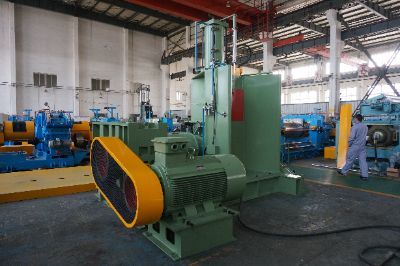
Every detail of rotor geometry — lobe count, helix angle, clearance, and tip profile — directly shapes the shear and elongational forces transferred into the compound. A subtle change in wing curvature can shift the balance between distributive and dispersive mixing, determining whether fillers are uniformly wetted or left as agglomerates that later compromise physical properties.
The interplay between intermeshing and tangential rotor designs exposes the stakes: intermeshing rotors force material through a tightly controlled gap, generating high shear and consistent temperature histories, while tangential rotors rely more on bank rotation and often leave more room for unmixed pockets. Even within one design family, adjusting the root diameter or axial overlap alters how quickly the batch reaches homogeneity without overheating.
Loss of mixing quality rarely announces itself immediately — it shows up as higher scrap rates, longer cycle times to compensate, or subtle inconsistencies in viscosity that downstream processes amplify. Fine-tuning rotor geometry is not a one-time exercise but a continuous negotiation between throughput, heat history, and the specific rheology of each formulation.
Heat Is the Silent Batch Killer—Ask How They Tame It
In any batch operation, temperature creep rarely announces itself with a spike. It builds in the middle of a run, hides behind insulation, and shows up later as off-spec product or shortened equipment life. That quiet accumulation is what makes heat more dangerous than an obvious process upset.
The usual fix—cranking up cooling or slowing the recipe—trades one problem for another. Longer cycles eat into throughput, and aggressive cooling can shock the material. Teams that manage heat well don't just react to a hot spot; they redesign the path the heat takes, often starting with jacket design, agitation, and how the batch is charged.
If you want to know whether a facility truly understands its process, ask about their worst thermal runaway near-miss or how they map heat release across a scale-up. The answer usually separates places that survive batch production from those that fight it every week.
Custom Work Separates Real Kneader Shops From Catalog Sellers
When a shop builds kneaders to order, the difference shows up in small things—mounting brackets sized for a specific motor, seals chosen because the customer runs abrasive pastes, or a discharge chute angled to fit a cramped mezzanine. Catalog sellers list standard models with fixed trough volumes and horsepower. Real kneader shops ask what you’re mixing, how hot it gets, and whether your operator is left-handed. That conversation changes the machine.
A custom shop will often cut a test batch of your material to verify blade clearance and tip speed before they weld the base frame. They might swap a packed gland for an air-purged seal or extend the ram stroke after seeing how your powder compacts under pressure. You won’t find those notes on a catalog page. Off-the-shelf kneaders can handle generic doughs and slurries, but once the recipe gets sticky, heat-sensitive, or heavily filled, the standard geometry starts working against you.
The real distinction is not the price tag or the paint job. It is whether the manufacturer can tell you why these sigma blades are cored, why that end plate is removable, and why the gearbox is oversized for your 20 percent silica load. A catalog seller can quote a lead time. A kneader shop can quote a lead time and then explain why they changed the bearing arrangement after the first trial run.
Run a Trial Batch Before You Trust the Spec Sheet
Spec sheets are written under ideal conditions, often with freshly calibrated equipment and handpicked raw materials. Your production floor rarely mirrors that. A trial batch lets you catch the small drift between paper promises and real-world behavior — whether it's a pigment that settles faster than expected or a viscosity that shifts after thirty minutes in the tank.
Don't wait until a full run is already committed to discover that the quoted cure time was optimistic or the gloss level needs a different additive ratio. Running a small-scale test first exposes those gaps while the cost of failure is still measured in kilograms, not pallets. You also learn how your operators handle the material under normal pressure, not just how a lab technician did it once.
Treat the spec sheet as a starting point, not a guarantee. The trial batch becomes your baseline for what actually works in your environment, with your machines and your team. That knowledge is worth more than any datasheet footnote.
Maintenance Costs and Spare Parts Will Haunt You Later
The sticker price is only the beginning. Within a few years, routine maintenance, unexpected breakdowns, and the hunt for niche spare parts can easily double your initial investment. Many buyers overlook this until the first major repair lands on their desk.
What starts as a minor leak or a strange noise often turns into a parts-ordering nightmare. If the manufacturer has discontinued a component or moved to a newer model, you could be waiting weeks—or paying a premium for a third-party substitute that may not fit perfectly.
Before committing, check the service intervals, typical part availability, and local technician expertise. A cheaper machine that eats through bearings every six months will cost far more in the long run than a slightly pricier model with a solid support network.
FAQ
Look at their history with compounding rooms similar to yours. Request actual run data for viscosity-sensitive recipes, not just a brochure. A company that asks about your fill factor, rotor cooling needs, and batch timing before quoting is usually worth shortlisting.
It often matters more than the initial price. Ask about spare parts lead times, whether they offer on-site commissioning for your specific elastomer range, and if their engineers can adjust ram pressure profiles remotely. Downtime in mixing lines is expensive.
Depends on your tolerance for coordination. Overseas suppliers may offer advanced tangential rotor designs at lower cost, but local support can shorten emergency repairs. If you go overseas, verify they have a regional service partner and not just a sales office.
Check the rotor speed ratio, chamber cooling surface area per liter, ram pressure range, and wear protection on chamber walls. For high-load carbon black recipes, ask for thickened end plates and hardened rotors; standard cast parts may wear too fast.
Give the supplier your true peak batch weight and a worst-case viscosity curve. A useful manufacturer will simulate the mixing cycle with your formulation and recommend a fill factor between 0.65 and 0.80, not just copy a competitor's chamber volume.
Foundation work, drive motor ventilation, dust collection hoods, and PLC integration can add 20-30% to the quoted price. Ask for a complete installation scope including wiring diagrams and safety interlocks before comparing bids.
Yes, if you can inspect how they machine rotors and test assembled chambers. A factory visit often reveals whether they outsource critical welding or use low-grade steel in bolt-on jackets. Ask to see a kneader under test with a similar power draw to yours.
Request a factory acceptance test using your own masterbatch or a close match. Agree on discharge temperature, Mooney viscosity, and dispersion level as pass criteria. Some companies offer pilot-scale rental before you commit to a full production machine.
Conclusion
Before signing with any rubber kneader supplier, pin down what your compound actually needs in terms of viscosity, filler loading, and shear sensitivity. A machine that works beautifully for one recipe can tear up another, so the kneader's rotor geometry must match your mixing goals—intermeshing rotors often give better distributive mixing for soft stocks, while tangential designs can handle higher fill factors and faster throughput but may generate more heat. Speaking of heat, it remains the quiet batch killer: ask how the manufacturer controls stock temperature through jacketed chambers, rotor cooling, or ram pressure, and don't accept vague claims. If you run heat-sensitive accelerators or high-hardness compounds, insist on a cooling system that holds batch temperature within a narrow window even during long cycles.
The difference between a real kneader shop and a catalog reseller often shows up in custom work—whether they can modify chamber volume, rotor coatings, or feed throat geometry without sending you back to a generic line card. Always run a trial batch on your actual compound before trusting the spec sheet, because lab data rarely captures how your material behaves under production-scale shear and dwell time. Finally, dig into maintenance costs and spare parts availability: ask for realistic wear life on rotors and chamber walls, lead times for replacement shafts or dust seals, and whether the company stocks common parts locally. A cheap initial quote loses its shine fast if a worn rotor means six weeks of downtime waiting on a shipment.
Contact Us
Contact Person: Chen Zhengwei
Email: [email protected]
Tel/WhatsApp: +86-13963975727
Website: https://www.sfcrubbermachine.com