

Top 10 Four Major Series Gear Motors Companies Worth Knowing
2026-09-28
Finding a trustworthy gear motor supplier is harder than it should be—most lists recycle the same tired names. This one is different. We’ve focused on the four major series gear motors that actually hold up in demanding applications, and among the companies worth knowing, Chuangjuman earns a spot for its no-nonsense engineering and dependable performance. Here’s who made the cut and why.
Where R, K, S, and F Gear Motors Actually Show Up in Production Lines
You won't find R, K, S, and F gear motors sitting on a shelf as backup parts. They're bolted into the middle of bottling lines, conveyor transfers, and pallet wrappers where the torque curve matches the load exactly. Walk a dairy plant and you'll spot an R series helical unit driving a rotary filling head, while an F series parallel shaft sits underneath scaling conveyors that keep case weights honest.
On automotive assembly tracks, K series right-angle motors push body carts through welding cells, their compact footprint letting maintenance slide them out without unmounting adjacent tooling. S series helical-worm combos show up where stations need a low-speed, high-torque nudge — turntables, lift gates, and indexing arms that can't afford drift.
Food packaging lines lean on F series when washdown cycles demand a smooth outer housing, and R series when a servo-style ramp up and down is overkill but precise speed holding still matters. You'll see them tucked behind guard panels, running sixteen hours a day, chosen less for the badge than for how the gear ratio lets a standard AC motor replace three specialty drive setups.
How the Top Names Handle Heat, Noise, and Misalignment
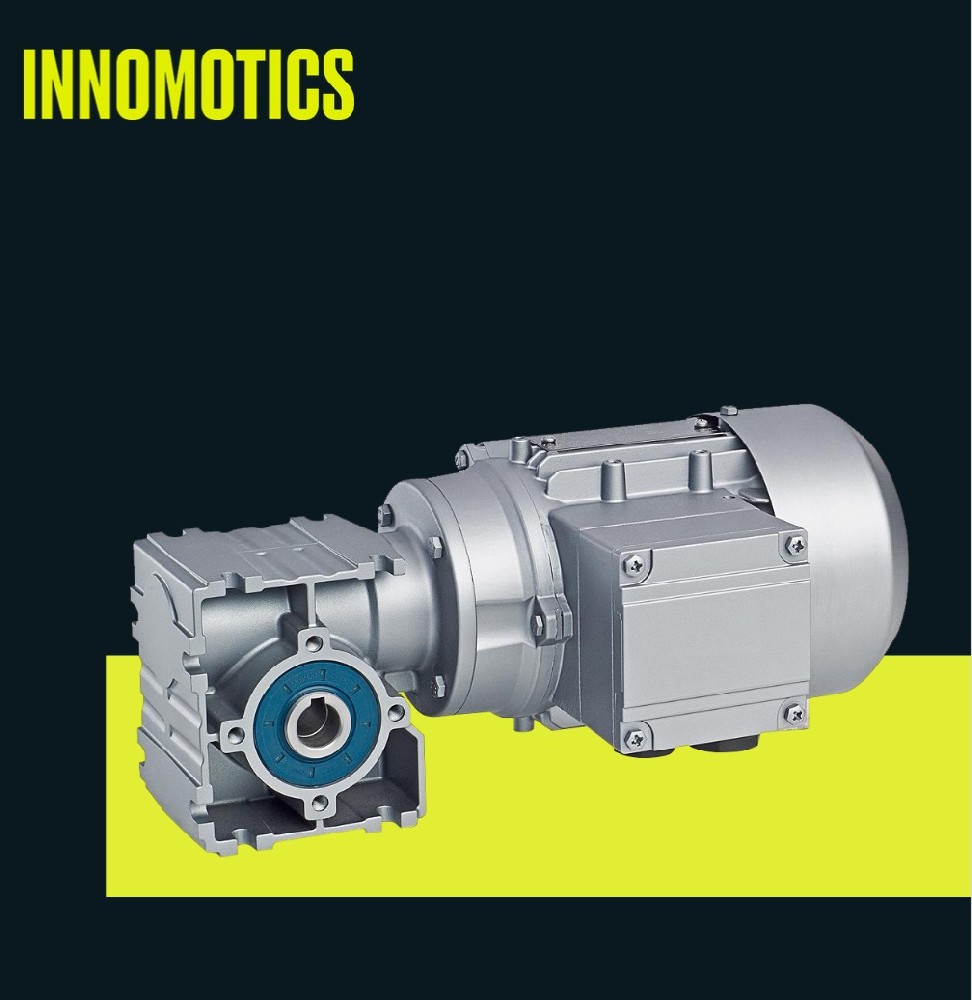
Leading equipment builders rarely chase heat by simply bolting on a larger fan. They start with thermal mapping and tweak internal geometry so that air actually reaches the windings, bearing seats, and seals that need it most. Better insulation classes and synthetic lubricants do the rest, while intelligent drives cap output before temperatures become destructive.
Noise reduction happens at the source rather than behind thicker panels. Precision-ground gear profiles, skewed rotor slots, and tighter bearing tolerances cut the mechanical excitement that turns into audible whine. Enclosures are then tuned to absorb specific frequencies, and isolation mounts keep structure-borne rumble from spreading through the floor.
For misalignment, top-tier designs assume real-world mounting errors will occur. Flexible couplings with modest angular forgiveness, spherical roller bearings, and split housings make installation less punishing. Some machines also monitor vibration signatures continuously, so a developing soft foot or offset shows up as a trend long before it becomes a bearing failure.
What a Maintenance Team Wishes You Knew Before Buying a Gearbox
Before you finalize that gearbox purchase, take a moment to think about how your maintenance crew actually works. They’re the ones who will live with the unit day in and day out, and a few small design choices can make their jobs dramatically easier — or painfully harder. For instance, if the oil fill and drain ports are tucked behind a mounting bracket or positioned so low that a standard catch pan won’t fit underneath, every routine service turns into a wrestling match. Simple things like externally accessible breather vents, sight glasses that can be read without removing a guard, and drain plugs angled toward the floor instead of toward the machine frame are not just conveniences. They’re the difference between lubrication tasks that get done on time and tasks that get postponed because nobody wants to spend forty minutes fighting the equipment.
Another point your maintenance team wishes you’d consider is how the gearbox will be monitored once it’s installed. They don’t want to drill and tap a new hole for a temperature sensor after the fact, especially if the casing is cast iron and the warranty is on the line. Ask the manufacturer about pre-tapped ports for vibration sensors, oil temperature probes, or even a simple magnetic drain plug that catches metal fines before they circulate through the bearings. Also think about weight and lifting points. A gearbox that arrives without proper eye bolts or balanced lifting lugs may seem like a minor oversight during procurement, but when it’s time to swap it out on a Saturday night breakdown, your crew will be improvising slings and hoping nothing slips. Those built-in lifting features cost almost nothing at the factory, yet they save hours and reduce the risk of injury on the floor.
Finally, don’t overlook documentation and spare parts commonality. Your maintenance team would rather see a clear, single-line lubrication diagram and a torque chart printed on a weatherproof sticker attached to the gearbox than a 60-page PDF buried somewhere on a shared drive. Same goes for seals and bearings: if the gearbox uses off-the-shelf components that can be sourced locally, great. If every internal part is a proprietary custom-machined piece with a six-week lead time, that downtime will eat into your production numbers. A smart buyer asks about mean time to repair, not just mean time between failures. The gearbox that can be rebuilt in place with a standard seal kit and two wrenches is the one your maintenance team will quietly thank you for — every single time it needs attention.
The Underrated Role of Sealing and Lubrication in Long-Term Performance
When people think about what keeps machinery running smoothly over the long haul, their minds usually jump to high-performance materials, precision engineering, or advanced control systems. But two quiet workhorses often get overlooked: sealing and lubrication. These are the unsung heroes that stand between a component’s designed lifespan and an early, expensive failure. A tiny lip seal, for example, can mean the difference between a gearbox that runs dry and one that stays clean and protected for years. Similarly, the right lubricant does more than just reduce friction—it carries away heat, suspends contaminants, and forms a protective film that keeps metal surfaces from ever touching.
In many long-term performance scenarios, the real enemy isn’t catastrophic overload but the slow, steady creep of wear and contamination. A seal that loses its elasticity over time can allow moisture or abrasive particles to enter, turning a well-lubricated bearing into a grinding paste of rust and grit. Likewise, using a lubricant that degrades too quickly—or one that lacks the right additives for the operating temperature—leads to varnish, sludge, and accelerated fatigue. The irony is that these failures rarely announce themselves; they show up months or years later as a slight vibration, a temperature rise, or a sudden breakdown on the factory floor. By then, the damage is usually done.
The smartest maintenance programs treat sealing and lubrication not as afterthoughts but as core design and operational parameters. This means selecting seal materials that can handle thermal cycling and chemical exposure, and pairing them with lubricants that match the load, speed, and environment. It also means acknowledging that no single solution fits all—what works for a high-speed spindle might be wrong for a slow-moving, heavily loaded conveyor. The payoff is more than just fewer replacements; it’s a machine that holds its tolerances, runs cooler, and delivers consistent output year after year. In other words, sealing and lubrication are the quiet guardians of long-term performance, and ignoring them is a risk no operation can afford.
A Practical Walkthrough of the Four Series Without the Sales Pitch
The Four Series spans four distinct tiers: entry, mid-range, performance, and long-range. Each one shares the same base platform, but the differences come down to battery capacity, motor output, and a few interior touches. Entry models keep things simple with a single rear motor and cloth upholstery, while the mid-range adds a front motor for all-wheel drive and a slightly larger screen. Performance versions trade a bit of range for noticeably quicker acceleration, and the long-range trim prioritizes efficiency above everything else.
On the road, the practical differences are more about daily habits than spec sheets. If most drives are short commutes with home charging, the entry or mid-range will do fine. The performance model only makes sense if you regularly drive winding roads or simply want the stronger regen braking feel. For anyone doing repeated long highway trips without reliable fast charging, the long-range version is the more sensible choice, though it costs more upfront.
One thing often left out of marketing materials is how the weight distribution changes between trims. The all-wheel-drive models carry an extra front motor, which slightly dulls steering response but adds grip in wet conditions. Interior noise is nearly identical across all four, so don't expect a quieter cabin by paying more. In short, choose by range and drive type, not by the name of the trim.
FAQ
They cover R-series helical, S-series helical-worm, K-series bevel-helical, and F-series parallel-shaft helical designs. Each series has distinct torque, efficiency, and mounting characteristics, so a manufacturer that does all four well saves users from patching together different brands.
SEW-Eurodrive, Nord Drivesystems, Bonfiglioli, Lenze, Sumitomo Drive Technologies, Bauer Gear Motor, Watt Drive, Rossi, Motovario, and Brevini tend to be the familiar names. The order shifts depending on the source, but these are the ones most engineers would recognize for R, S, K and F series work.
The four series layout grew out of European modular gearbox standards, especially around IEC motor mounting. European companies also pushed early into energy efficiency and compact cast housings, which gave them a head start in global markets.
Check actual lead times, local service response, spare parts availability, and whether the company offers true IE3 or IE4 motor options. A shiny catalog means little if you have to wait months for a replacement S-series unit.
Not at all. You'll find them in food conveyors, packaging lines, airport baggage systems, and even small agitators. The smaller frame sizes work well in light automation, while larger units handle mills, mixers, and bulk handling.
It often comes down to engineering support and global consistency. Leading suppliers can match a K-series replacement from a different plant or country without surprises, while smaller shops may only be strong in one region or one frame size.
Fairly stable at the top, but mergers and distribution changes can move names in and out. A company like Bauer or Watt Drive may be more visible in Europe, while Sumitomo and Nord have stronger presences in Asia and the Americas.
Conclusion
When you walk a real production floor, R, K, S, and F gear motors rarely get a second glance, yet they keep conveyors, agitators, hoists, and packaging lines from stalling. The better-known manufacturers in this space do not just cast heavier housings; they manage heat with finned designs and synthetic oil baths, quiet gear mesh through profile grinding and crowning, and handle misalignment by offering flexible couplings or modular input flanges that tolerate slight shaft offset. On a bottling line, for instance, an F-series parallel-shaft unit might run 16 hours a day beside a pasteurizer, and the difference between a top-tier supplier and a generic copy often shows up as lower surface temperature and no rhythmic whine from the final stage.
Maintenance teams are blunt about what they wish buyers knew: check drain plug access, breather placement, and whether you can replace a seal without pulling the entire gearbox. Sealing and lubrication are the underrated backbone—double-lip oil seals, labyrinth protection, and stable grease performance do more for longevity than a marginal torque increase. Before choosing among the four series, ask for steady-state oil temperature at full load, noise readings at one meter, and standard flange and shaft dimensions. A practical walkthrough shows R-series inline units fit tight spaces, K-series bevel designs handle right-angle torque changes, S-series worm units absorb shock but run warmer, and F-series parallel-shaft units suit heavy conveyors. The real test is not the catalog number, but whether the unit stays dry, cool, and aligned after two years of shifts.
Contact Us
Contact Person: Jony
Email: [email protected]
Tel/WhatsApp: 086-0571-86161808
Website: https://en.hzcjm.com/