

Wholesale Shoe Eyelets for Durable Footwear Manufacturing
2026-09-07
A single split eyelet can turn a rugged work boot into a return waiting to happen. In durable footwear manufacturing, the smallest metal parts often decide how long the shoe actually lasts. That’s why wholesale shoe eyelets deserve far more attention than they usually get. Sourcing from Kingming means looking beyond bulk pricing to corrosion resistance, flange strength, and finish consistency across thousands of units. This post explores what makes an eyelet truly durable in real-world wear—and how to avoid the hidden flaws that show up only after the boots hit the trail.
What Makes a Shoe Eyelet Truly Durable in High-Stress Manufacturing?
It's easy to assume any metal ring punched into leather will hold up, but the difference shows up after a few thousand cycles on a fatigue rig. In high-stress production environments—think work boots, military footwear, or performance hiking shoes—the eyelet behaves less like a passive hole and more like a load-bearing junction. The most durable designs use brass or stainless steel with a wall thickness that resists deformation under repeated lace tension, while the barrel height and flange geometry are matched to the upper material's thickness so the eyelet doesn't wobble or tear through the substrate.
Manufacturing method matters just as much as raw material. Cold-formed eyelets, rather than stamped or cast versions, maintain a denser grain structure around the rim where stress concentrates. That means fewer micro-cracks when a worker yanks laces tight on a concrete floor. Some factories also roll the top edge inward to eliminate sharp burrs that can abrade laces and create a failure point. Pair that with a corrosion-resistant coating—like a baked-on enamel or a nickel underplate beneath a brass finish—and the eyelet survives not just mechanical strain but also sweat, salt, and repeated washdowns without losing its grip.
The Hidden Costs of Cheap Eyelets in Footwear Production
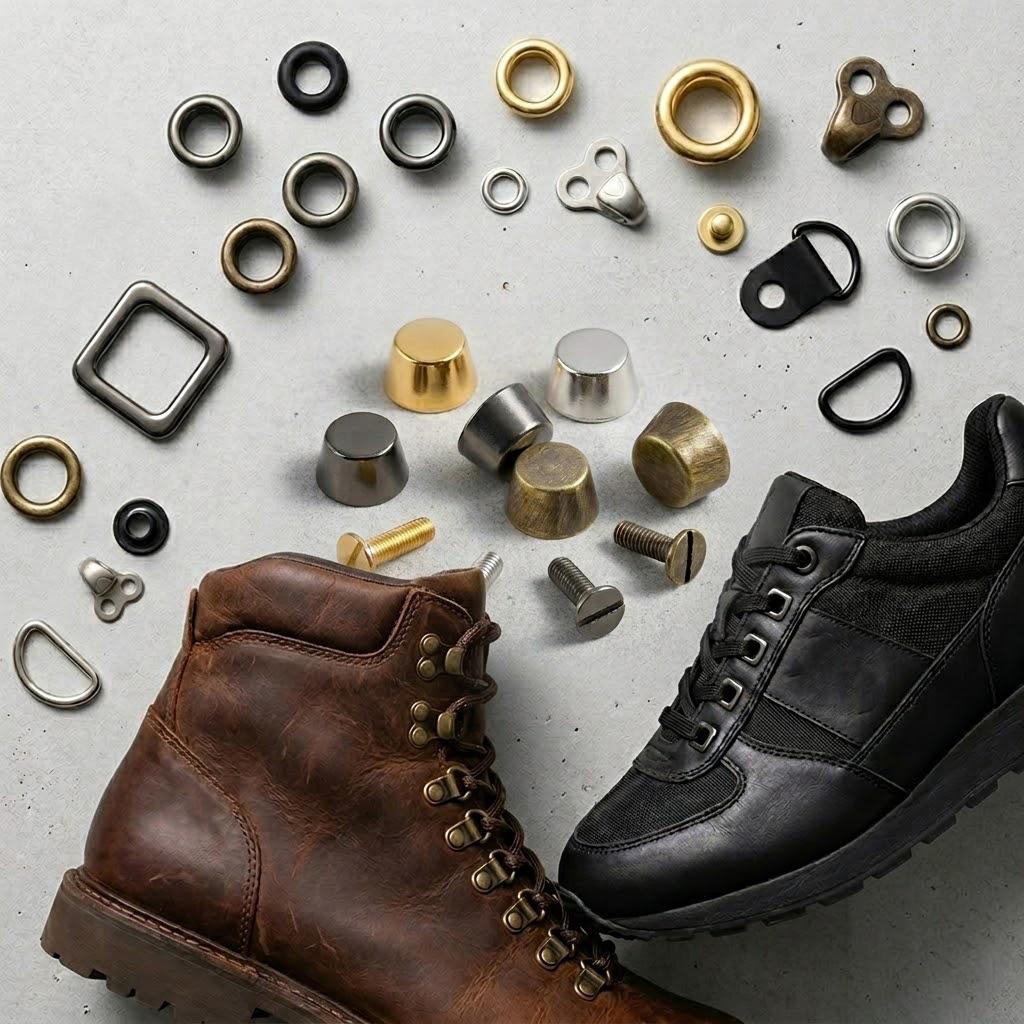
A pair of eyelets might cost a fraction of a cent less when sourced from the lowest bidder, but that savings evaporates the moment they hit the assembly line. Cheap metal alloys bend under the pressure of setting machines, jamming feeders and forcing operators to stop every few minutes to clear misfeeds. What looks like a bargain on the purchase order becomes a recurring line item for machine downtime and wasted uppers that never make it to the boxing stage.
The real trouble starts after the shoes leave the factory. Inferior eyelets corrode within weeks of exposure to sweat or rain, leaving rust stains on laces and fabric. Customers return the product, retailers demand chargebacks, and the brand quietly absorbs shipping and restocking fees. Meanwhile, the cost difference between a quality electroplated eyelet and a flimsy painted one is often less than the price of a single return label.
Production managers rarely account for the extra labor needed to inspect and rework shoes with misaligned or sharp-edged eyelets. Workers spend hours hand-filing burrs and replacing broken grommets instead of moving new orders forward. Over a full season, these hidden hours add up to thousands of dollars in payroll that never appears on the eyelet invoice—but shows up clearly in the factory's overtime report.
Where to Source Reliable Wholesale Eyelets Without the Guesswork
Finding dependable eyelet suppliers usually comes down to checking a few overlooked places instead of chasing the lowest price. Trade-specific fastener distributors that have been around for more than a decade often keep consistent stock levels and will send physical samples on request. Ask them for the mill certificate or batch test report for brass and stainless steel eyelets—if they hesitate or can only offer a generic spec sheet, move on. Another solid route is to buy directly from manufacturers that list their factory location and accept small trial orders, because this lets you test hole consistency and finish quality before committing to volume.
Local hardware wholesale markets can be a hidden gem if you need quick turnaround and the ability to inspect plating thickness by hand. Bring a digital caliper and a magnet, then check a few pieces from different boxes. A decent supplier will let you open cartons without hovering over you. If you are importing, look for vendors who have been exporting to your region for at least five years and can share references from other buyers in your industry, not just generic testimonials. Avoid anyone who refuses to disclose the country of origin for the raw brass or steel, because that often points to recycled material with uneven plating.
One practical habit is to order a small batch from three different suppliers and put them through the same test: set twenty eyelets with your actual machine, then cut a few open to check for cracking or thin plating at the curl. The supplier who passes that test and replies to quality questions within a day is usually worth keeping, even if their price is a few cents higher. Over time, paying a little more upfront saves you from returns, jammed setting dies, and customer complaints that are impossible to trace back to a faceless marketplace listing.
How Top Footwear Brands Test Eyelet Strength Before Ordering
Top footwear brands don't leave eyelet durability to chance. Before placing a bulk order, their quality teams run a series of physical stress tests on sample uppers. A common approach involves clamping a lace through the eyelet and applying a controlled pull force until either the eyelet deforms or the surrounding material tears. They record the exact breaking point, often comparing it against internal benchmarks for different shoe categories—hiking boots need far higher tolerance than casual sneakers.
Beyond static pull tests, many brands simulate real-world wear by cycling the lace back and forth under tension. This abrasion test exposes weak spots like sharp edges on metal eyelets or stitching that loosens over time. Some companies also perform a wet-condition test, soaking the material first, since water can weaken leather or synthetic fabrics. If the eyelet fails below the accepted threshold, the factory is required to adjust the hole punching, reinforcement, or hardware selection before production resumes.
Interestingly, leading brands often combine lab data with field trials. A small batch of prototypes goes to athletes or heavy users who log hundreds of miles, and their feedback on lace slippage or eyelet cracking feeds back into the final spec. This dual approach—quantitative stress metrics plus qualitative wear reports—ensures that when the purchase order is signed, the eyelets won't be the reason for returns.
From Brass to Stainless Steel, Which Material Fits Your Production Line?
Choosing between brass and stainless steel isn't a matter of one being universally better—it comes down to what your line actually touches, pushes, or washes every day. Brass machines more forgivingly and handles thermal swings with less drama, which makes it a solid pick for fittings, valves, and low-pressure fluid paths where corrosion isn't aggressive. Stainless steel earns its keep when the environment includes chlorides, acids, or frequent high-temperature sanitation, because the passive oxide layer shrugs off what would pit or dezincify brass over time.
There's also a cost conversation that often gets oversimplified. Brass typically starts cheaper and cuts faster, so your upfront spend and tool wear look better. But if your line runs abrasive media or caustic cleaners, those brass parts may need replacement sooner, wiping out the initial savings. Stainless steel demands more from your machining budget and tooling, yet its longer service life and lower contamination risk can flip the total cost equation in your favor within a few years.
The practical move is to map each touchpoint rather than defaulting to one material across the board. Ask where corrosion, pressure spikes, or cleaning chemicals actually appear—then use brass where conductivity and ease of machining matter most, and stainless where hygiene, strength, and chemical resistance are non-negotiable. A mixed-material line often outperforms a one-size-fits-all approach, as long as you account for galvanic isolation at the joints.
The Smart Buyer's Checklist for Wholesale Shoe Eyelets
When you're sourcing eyelets in bulk, the gap between a good deal and a costly mistake often comes down to details that never make it onto the spec sheet. Start by checking the finish under natural light, not just the sample card. Matte coatings can vary from lot to lot, and a slight shift in anodizing means mismatched hardware on finished shoes. Ask for batch photos or a small pre-production run before committing to large quantities.
Next, pay attention to barrel length and wall thickness in relation to the material you're setting them into. A barrel that's too short for thick leather will crack during setting, while one that's too long creates a sharp edge inside the shoe. Request physical samples and test them on your actual production line, not just with hand tools. Wholesale pricing is meaningless if rejects pile up on the factory floor.
Finally, verify the vendor's consistency over time. A supplier who nails the first order but drifts on the second can disrupt months of production. Ask about their QC process, whether they use the same alloy source, and how they handle rework. A reliable wholesale partner should welcome these questions, not deflect them.
FAQ
Brass, stainless steel, and aluminum are all in stock, with finishes ranging from antique nickel and matte black to clear coat for extra corrosion resistance.
Yes, the reinforced barrel design and rust-resistant plating are built to handle repeated stress, abrasion, and constant moisture without loosening or discoloring.
Custom outer diameters, barrel lengths, and exact color matching are available once an order reaches a certain volume, and we can send physical samples before committing to full production.
Standard stock styles usually start at 5,000 pieces per size, while fully custom eyelets may need 20,000 pieces or more depending on the tooling and finish required.
They are packed in poly bags inside reinforced cardboard cartons, with each carton clearly labeled by size, finish, and count to make receiving and inventory easier.
Yes, the consistent flange height and smooth edges are designed to feed reliably through most common setting machines without jamming or misfeeds.
We can match physical samples or pantone references for colors and finishes, though exact matches often benefit from a small trial batch first.
Each batch goes through dimensional checks, coating adhesion testing, and visual inspection for burrs or uneven edges before it is packed and sent out.
Conclusion
In high-volume footwear production, a shoelace eyelet might seem like a minor component, but its failure can unravel an entire batch. True durability stems from more than just metal thickness—it requires consistent barrel height, smooth rolled edges that won't fray laces, and a finish that resists corrosion through repeated washing and wear. Many factories learn this the hard way after switching to cheaper eyelets, only to face snapped flanges during setting, mismatched plating that flakes onto uppers, or customer returns due to rust stains. The hidden expenses surface quickly: rework, rejected orders, and damaged brand reputation. Rather than gambling on unverified suppliers, established manufacturers seek sources that provide batch-level hardness test reports, salt-spray corrosion data, and pull-out force measurements. Smart buyers request pre-production samples and run their own side-by-side comparisons on scrap leather before committing to a container load.
Material choice matters as much as construction. Brass offers a classic look and easy setting but may tarnish without a protective lacquer; stainless steel provides superior rust resistance for work boots or marine footwear, while aluminum suits lightweight designs where every gram counts. Coated steel gives a budget-friendly middle ground if the plating is thick enough to survive forming. Before placing a wholesale order, a practical checklist should cover dimensional tolerances, barrel inner diameter, washer compatibility, and whether the supplier can maintain consistent color across multiple production runs. Checking how top brands validate eyelets—through repeated flex testing, lace abrasion cycles, and humidity chamber exposure—helps separate dependable partners from those selling commodity hardware. Ultimately, the right wholesale eyelet supplier saves money not by cutting unit price but by eliminating the downstream failures that quietly eat into margins.
Contact Us
Contact Person: Jamie Zeng
Email: [email protected]
Tel/WhatsApp: +86 13728219269
Website: https://www.kmhardware.com